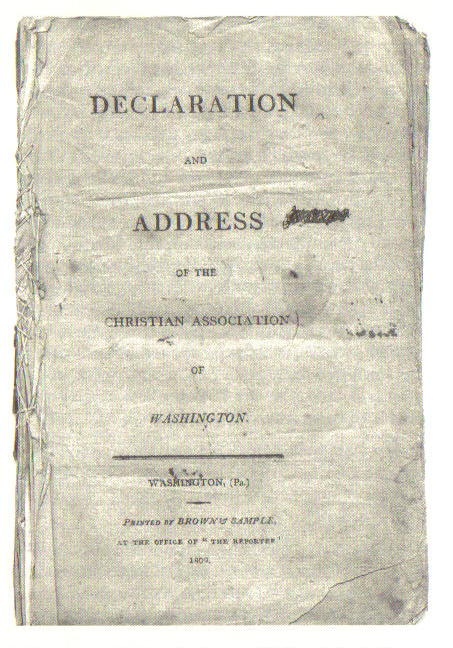
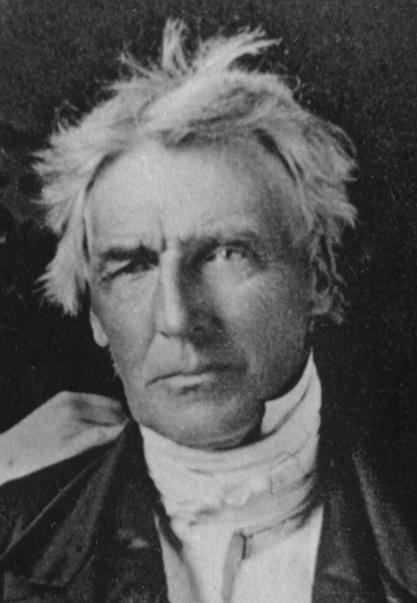
After his censure and withdrawal from the Seceder Presbyterians, Thomas Campbell gathered his hearers into the Christian Association of Washington — deliberately not a church, but a voluntary society for promoting simple evangelical Christianity. The *Declaration and Address* was written to explain it.
Why an association and not a church
By the summer of 1809 Thomas Campbell had no pulpit, no salary, and no ministerial standing. He had also not stopped preaching. Farmhouse parlors and maple groves in Washington and Allegheny counties had filled with people who wanted to keep hearing him, and the question of what they now were could not be deferred much longer.
His answer was carefully negative. The group that met on 17 August 1809 constituted itself as an *association* — a voluntary society for the promotion of simple evangelical Christianity — and explicitly not as a church. It would ordain no one, discipline no one, and administer no ordinances. Its members were expected to remain in whatever congregations they already belonged to.
That distinction was the whole point. Campbell had just been tried for treating the fences between Christian bodies as human inventions. To respond by founding a new body would have been to build one more fence and call it the last. An association could plead for unity without becoming another party to it.
The document it produced
The Association appointed Campbell to write out its rationale. What he produced was the [*Declaration and Address*](/documents/declaration-and-address-1809/), printed three weeks later, on 7 September — a sixty-page argument that the church of Christ on earth is "essentially, intentionally, and constitutionally one," and that nothing should be bound on Christians as a term of communion that is not expressly taught in the New Testament.
The Association's self-denial did not hold. Rebuffed by the Synod of Pittsburgh when it applied for recognition, and increasingly pressed by the question of baptism, the group constituted itself as the [Brush Run Church](/events/brush-run-church-1811/) in May 1811 and began ordaining its own ministers. The movement that insisted it was not starting a church had started one within two years — a tension it never fully resolved and has been arguing about ever since.