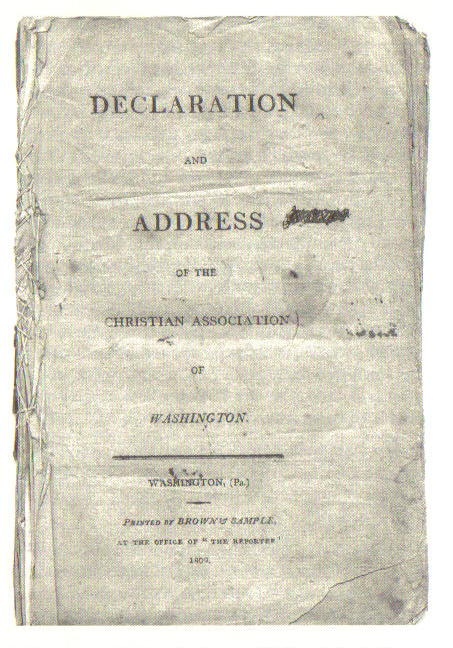
Thomas Campbell issued this 1809 manifesto as the charter document of the Christian Association of Washington, pleading for visible unity grounded in the New Testament alone and rejecting creedal tests of fellowship.
Historical Context
The Declaration & Address emerged from the frontier turmoil that followed Thomas Campbell’s suspension from the Presbyterian Synod of Pittsburgh. In forming the Christian Association of Washington he called believers to cooperate for evangelism and mutual encouragement without erecting new sectarian walls.
On 7 September 1809 the association adopted this foundational document. It opens with a concise declaration describing the aims of the fellowship, and continues with an extended address that outlines principles for unity, Christian liberty, and cooperative mission.
The Declaration (abridged)
“We form ourselves into a religious association, under the denomination of the Christian Association of Washington. We mutually agree to cooperate for the promotion of simple evangelical Christianity, free from all mixture of human opinions and inventions. The Holy Scriptures of the Old and New Testaments shall be our only rule of faith and practice; and according to the divine plan, the pattern laid down in the New Testament, we shall endeavor to reduce the whole of practical godliness, trust, and obedience to that original standard.”
Campbell insisted that the association would not become a new denomination. It existed to promote unity, to furnish opportunities for worship and teaching, and to support ministers devoted to Scripture and mission. Membership rested on “the simple profession of faith in Christ, and obedience to him in all things.”
Principles for Unity (selected propositions)
- Proposition 1. The church of Christ on earth is fundamentally one, composed of all in every place who profess faith in Christ and obedience to him according to Scripture.
- Proposition 2. Though Christians necessarily gather in distinct local societies, those churches should maintain fellowship without schism or uncharitable division.
- Proposition 3. Nothing should be required as an article of faith or term of communion except what God’s word expressly teaches and enjoins.
- Proposition 4. While Old and New Testaments belong together, the New Testament is a complete constitution for the worship, discipline, and government of the church.
- Proposition 5. Where Scripture does not specify the exact time or manner of an ordinance, no human authority may legislate for the church or impose new ordinances.
- Proposition 6. Fair inferences from Scripture may be true, but they are not binding on the conscience as terms of communion unless believers plainly perceive them.
- Proposition 7. Doctrinal systems and defenses of truth may be useful, but because they involve human reasoning they should not be made conditions of Christian communion.
- Proposition 8. Admission to the church does not require full knowledge of every revealed truth, but a sincere profession of faith and obedience according to one’s Scriptural understanding.
- Proposition 9. Those who make such a profession and show its reality in life should regard one another as saints and brethren, not as strangers to Christ.
- Proposition 10. Division among Christians is a dreadful evil: anti-Christian, anti-scriptural, and destructive of the peace and witness of the church.
- Proposition 11. Corruptions and divisions arise when people neglect God’s revealed will or impose human opinions and inventions as terms of communion.
- Proposition 12. The church’s highest purity requires faithful admission, faithful discipline, ministers who teach only revealed truth, and ordinances kept without human additions.
- Proposition 13. Where unavoidable practical circumstances are not specified in revelation, the church may adopt only necessary human expedients without letting them become causes of contention or division.
Final Appeal
Campbell closes by pleading with Christians to "come frankly forward" to the New Testament, to honor the liberty of conscience, and to pursue holiness and mission together. He warns that division undermines evangelism and obscures the witness of Christ’s church.
“That our Lord’s prayer for the unity of his people may speedily be answered; that his kingdom may come, and his will be done on earth as it is in heaven, is the ardent prayer of your sincere friends and servants in the Lord.”