⚠️ Draft Site: This site is currently under development. Details may be incomplete or incorrect.
Guided Archive

Documents Archive

A curated entry point for foundational texts, periodicals, and longer reading paths across the Stone-Campbell movement.

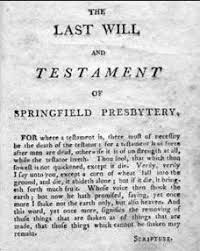
Last Will and Testament of the Springfield Presbytery
Covenant

Last Will and Testament of the Springfield Presbytery

Barton W. Stone and four fellow ministers publicly dissolved their Presbyterian judicatory, surrendering titles and authority so the congregation at Cane Ridge and its partners could simply be known as "Christians."
Barton W. Stone and colleagues · 28 June 1804 · Cane Ridge, Bourbon County, Kentucky

Declaration & Address
Pamphlet

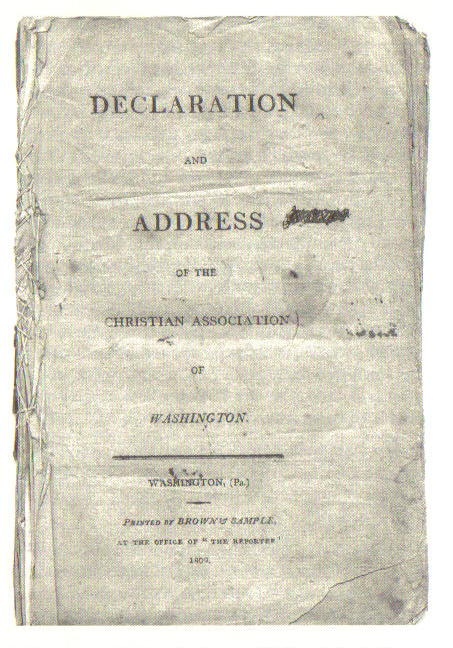
Declaration & Address

Of the Christian Association of Washington

Thomas Campbell issued this 1809 manifesto as the charter document of the Christian Association of Washington, pleading for visible unity grounded in the New Testament alone and rejecting creedal tests of fellowship.

Thomas Campbell · 7 September 1809 · Washington, Pennsylvania

The Christian Baptist
Periodical

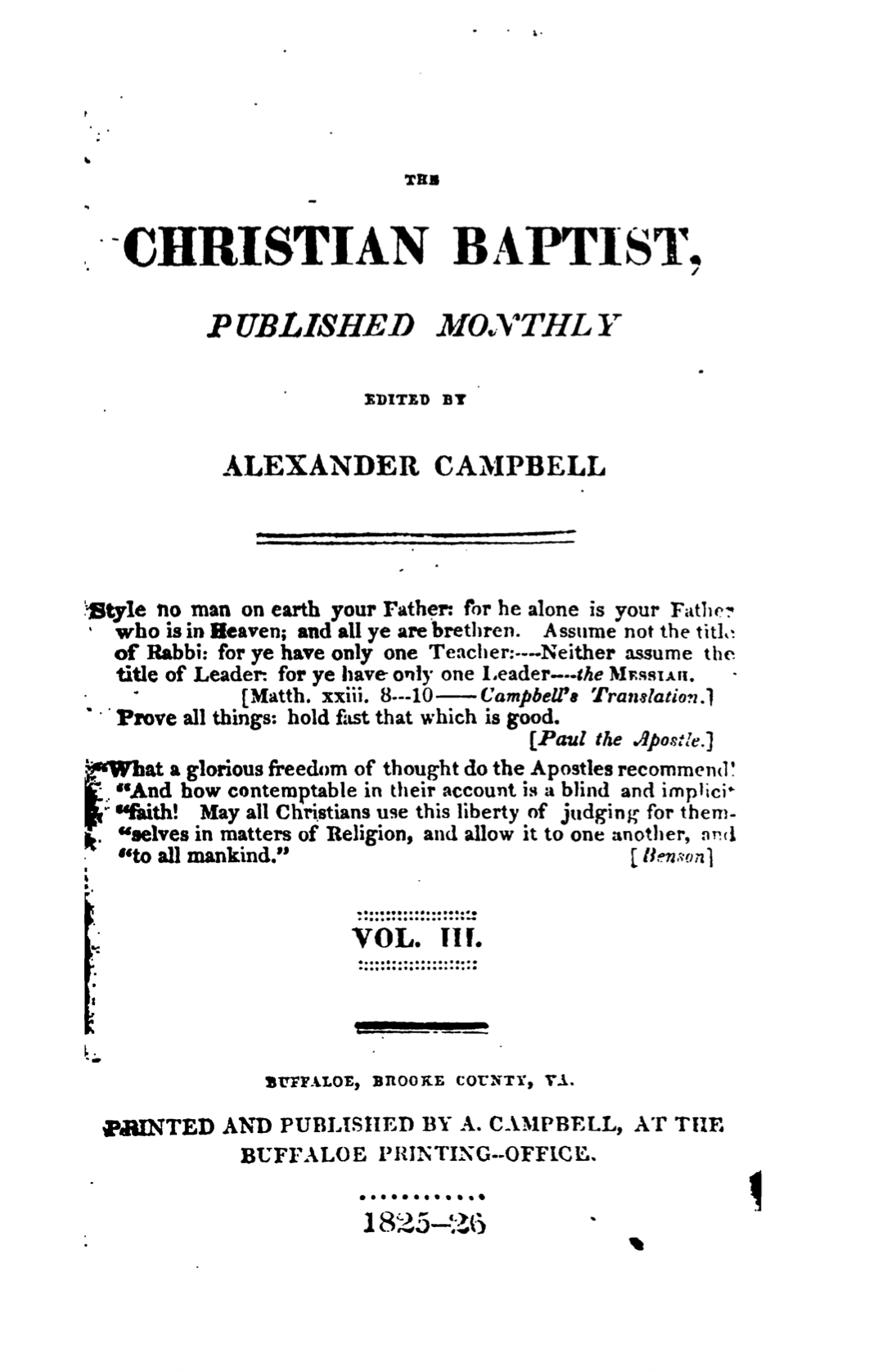
The Christian Baptist

Monthly Essays on the Ancient Order of Things

A feisty monthly that challenged denominational tradition, defended believer's baptism, and tested the Restoration plea in public print.

Alexander Campbell · 1823–1830 · Bethany, Virginia (now West Virginia)

Reader's note

Campbell's early monthly essays give the clearest view of the movement's polemical voice and publishing habits.

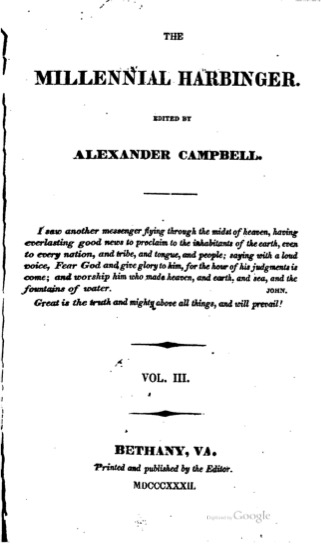
Millennial Harbinger
Periodical

Millennial Harbinger

A Monthly Series Devoted to Primitive Christianity

Campbell's flagship periodical became the movement's main forum for essays, debates, and correspondence.

Alexander Campbell · 1830–1870 · Bethany, Virginia (now West Virginia)

Reader's note

The Harbinger broadens the lens from controversy to constructive reform, education, and mission.

Book

Regeneration

Alexander Campbell's Regeneration is a systematic theological treatise originally published in the Millennial Harbinger, presenting his distinctive view that regeneration encompasses fact, testimony, faith, repentance, immersion, and the gift of the Holy Spirit as an integrated process of spiritual renewal. Campbell argues that immersion (baptism) is not merely a symbol but the divinely ordained "bath of regeneration" through which the believer receives remission of sins and the indwelling Spirit. The work became one of the defining statements of Restoration Movement theology on conversion and Christian initiation.

Alexander Campbell · 1836 · Pittsburgh, Pennsylvania

The Biography of Eld. Barton Warren Stone
Biography

The Biography of Eld. Barton Warren Stone

Written by Himself, with Additions and Reflections by Elder John Rogers

Stone's autobiography, completed and supplemented by his protégé Elder John Rogers after Stone's death in 1844. Bound together with the Apology of the Springfield Presbytery (1804) and Rogers' six-chapter portrait of Stone's character, this is the principal first-person source for Stone's life, the Cane Ridge revival, the founding of the Christian movement, and the 1832 Stone–Campbell union.

Barton W. Stone & Elder John Rogers · 1847 · Cincinnati, Ohio

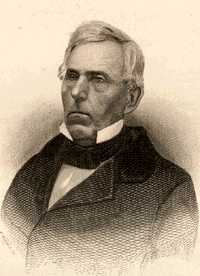
Tolbert Fanning, co-founder of the Gospel Advocate
Periodical

Gospel Advocate

A Southern Voice for Primitive Christianity

Fanning and Lipscomb shaped a durable journal of congregational life, Bible study, and moral formation.

Tolbert Fanning & William Lipscomb · 1855–Present · Nashville, Tennessee

Reader's note

A strong entry point for learning how the Restoration movement developed in the South after the Civil War.

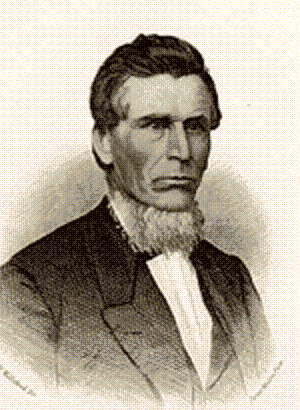
Moses E. Lard, editor of Lard's Quarterly Review
Periodical

Lard's Quarterly Review

Essays on Doctrine and Church Practice

Lard's review shows the more technical, bookish side of the movement's theological debate.

Moses E. Lard · 1863–1868 · Lexington, Kentucky

Reader's note

Short-lived, but important for seeing how movement leaders handled doctrine, controversy, and exegesis.