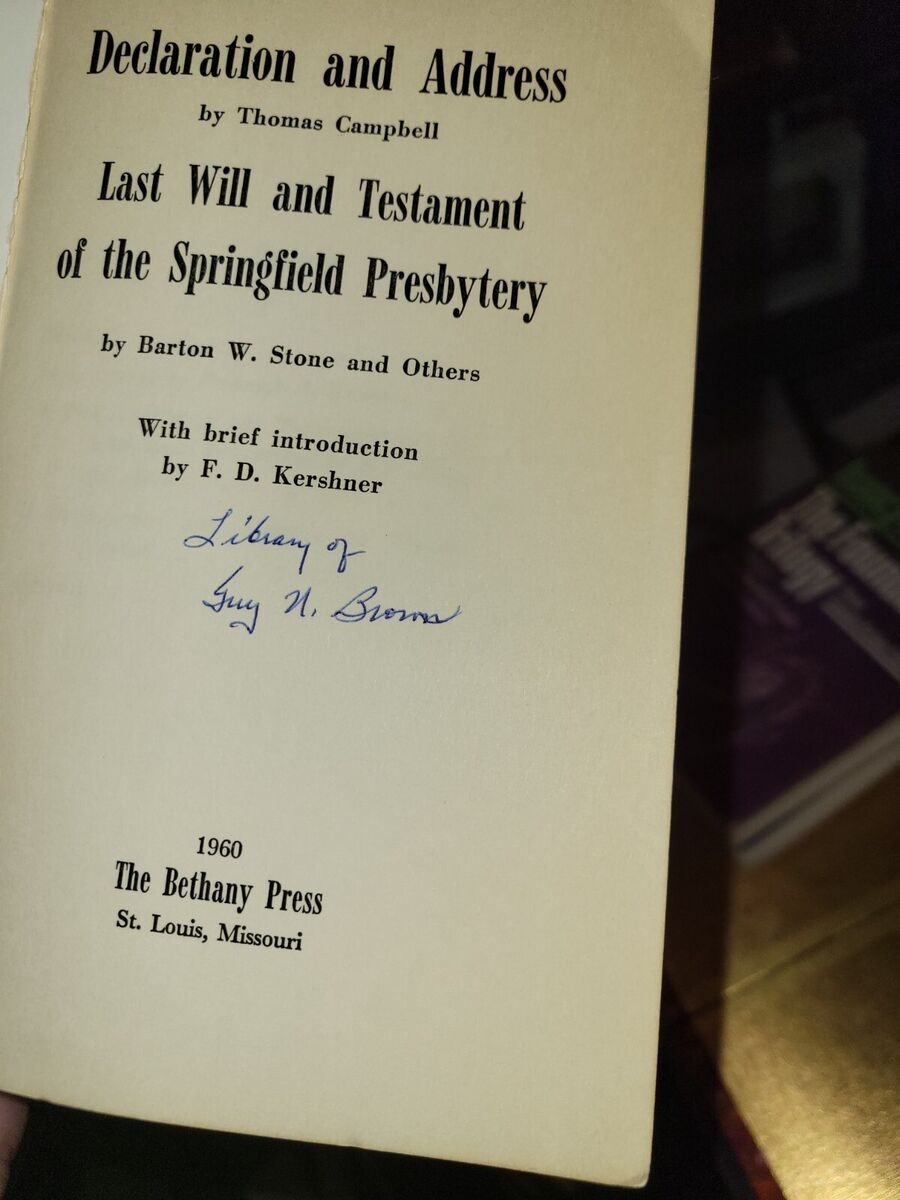
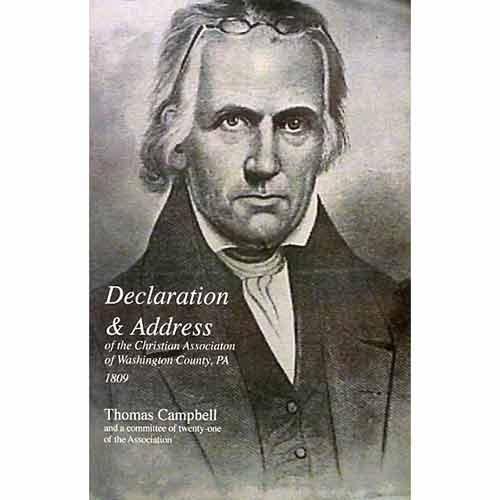
Thomas Campbell issued this 1809 manifesto as the charter document of the Christian Association of Washington, pleading for visible unity grounded in the New Testament alone and rejecting creedal tests of fellowship.
Historical Context
The Declaration & Address emerged from the frontier turmoil that followed Thomas Campbell’s suspension from the Presbyterian Synod of Pittsburgh. In forming the Christian Association of Washington he called believers to cooperate for evangelism and mutual encouragement without erecting new sectarian walls.
On 7 September 1809 the association adopted this foundational document. It opens with a concise declaration describing the aims of the fellowship, and continues with an extended address that outlines principles for unity, Christian liberty, and cooperative mission.
The Declaration (abridged)
“We form ourselves into a religious association, under the denomination of the Christian Association of Washington. We mutually agree to cooperate for the promotion of simple evangelical Christianity, free from all mixture of human opinions and inventions. The Holy Scriptures of the Old and New Testaments shall be our only rule of faith and practice; and according to the divine plan, the pattern laid down in the New Testament, we shall endeavor to reduce the whole of practical godliness, trust, and obedience to that original standard.”
Campbell insisted that the association would not become a new denomination. It existed to promote unity, to furnish opportunities for worship and teaching, and to support ministers devoted to Scripture and mission. Membership rested on “the simple profession of faith in Christ, and obedience to him in all things.”
Principles for Unity (selected propositions)
- Proposition 1. “The Church of Christ upon earth is essentially, intentionally, and constitutionally one,” made up of all who confess Christ and obey him according to the Scriptures.
- Proposition 2. Locally distinct congregations must maintain visible fellowship, permitting “no schisms, no uncharitable divisions” among those Christ has received.
- Proposition 3. Nothing may be required as an article of faith or term of communion except what is expressly taught and enjoined in the New Testament.
- Proposition 4. Where Scripture is silent the church must allow liberty: opinions and inferences may be held, but they cannot be imposed as conditions of fellowship.
- Proposition 5. Approved examples and apostolic precedents should guide practice, yet believers must distinguish between the substance of the faith and cultural circumstances.
- Proposition 6. Only those who make the “good confession” that Jesus is the Christ and walk in obedience to him may be received as members of the church.
- Proposition 7. Divine authority for church order, discipline, and worship belongs to Christ alone; therefore nothing should be called essential except what enjoys his explicit sanction.
- Proposition 8. Every congregation possesses the right of self-government under Christ. Delegated assemblies may offer advice and cooperation, but they must not impose laws binding the conscience.
- Proposition 9. Believers ought to resolve their differences by patient investigation of the Scriptures, free discussion, and brotherly forbearance.
- Proposition 10. Promoting unity requires that Christians “consider each other as brethren” and maintain communion even while continuing to study and reform together.
- Proposition 11. The commands and ordinances of Christ should be observed exactly as delivered by the apostles; all human innovations must yield to the New Testament pattern.
- Proposition 12. Civil rulers deserve obedience in their proper sphere, yet ecclesiastical tyranny and compulsion in religion contradict the gospel.
- Proposition 13. The entire project rests on the conviction that “division is a horrid evil,” while unity in Christ is both possible and commanded.
Final Appeal
Campbell closes by pleading with Christians to "come frankly forward" to the New Testament, to honor the liberty of conscience, and to pursue holiness and mission together. He warns that division undermines evangelism and obscures the witness of Christ’s church.
“That our Lord’s prayer for the unity of his people may speedily be answered; that his kingdom may come, and his will be done on earth as it is in heaven, is the ardent prayer of your sincere friends and servants in the Lord.”